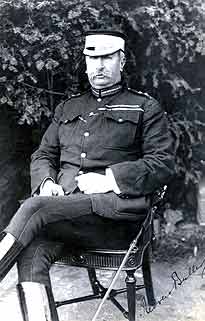
 Son
of James Wentworth Buller, M.P., of Crediton, Devonshire,
and the descendant of an old Cornish family, long
established in Devonshire, tracing its ancestry in
the female line to Edward I., he was born in 1839
at Downes, Crediton, Devon, and educated at Eton.
He was a major benefactor in Crediton and Exeter during
the early years of the last century. He was General
Officer Commanding at Aldershot, October 1898 to October
1899 and January to October 1901
Son
of James Wentworth Buller, M.P., of Crediton, Devonshire,
and the descendant of an old Cornish family, long
established in Devonshire, tracing its ancestry in
the female line to Edward I., he was born in 1839
at Downes, Crediton, Devon, and educated at Eton.
He was a major benefactor in Crediton and Exeter during
the early years of the last century. He was General
Officer Commanding at Aldershot, October 1898 to October
1899 and January to October 1901Commissioned into
the 60th Rifles (King’s Royal Rifle Corps) in
May 1858 he served in the Peking expedition of 1860,
in the Red River Rebellion (Canada) 1870, and Ashanti
(Ghana) 1873-4, where he came to the notice of General
Garnet Wolsley. He then served in South Africa during
the Kaffir War, 1878 and the Zulu War, 1879, where
he commanded a Regiment of irregular horse. Buller
lost approximately ninety men of his force in the
retreat from Inhlobane where he was awarded the Victoria
Cross for rescuing three of his men from the Zulus.
He served as Chief
of Staff in the first Boer War and then to General
Wolsley in both the Egyptian campaign of 1882, where
he was commended for coolness under fire at Tamai,
and the Gordon relief expedition of 1885. He was employed
as a civilian on police duties in Ireland in 1886
but returned to the Army as Quartermaster General
and then Adjutant General for the next eleven years,
from 1887 to 1897.
As GOC at Aldershot
in 1899 Buller became commander of the Field Force
for Natal during the South African War. Following
a series of setbacks in South Africa, Lord Roberts
replaced Buller. Notwithstanding that, Buller returned
to a heroes welcome in Aldershot in January 1901.
A disagreement over
policy led to his retirement in October 1901 and he
died in Devon in June 1908, aged sixty-eight. He is
remembered as the ‘father’ of the Army
Service Corps (now incorporated in the Royal Logistics
Corps). The Royal Logistics Corps barracks, in Aldershot,
bear his name.
Many references to
his name and deeds can be found in Exeter, including
Buller Road and Ladysmith schools. At the junction
of New North Road and Hele Road in Exeter can be seen
the statue of the General sat astride his horse, as
he must often have been seen leading his troops on
the battlefields of South Africa. The statue was unveiled
in 1905 and thousands of people attended, including
General Buller himself. Seen as the saviour of the
Boer War, he was acclaimed as having saved Natal from
the Boers.