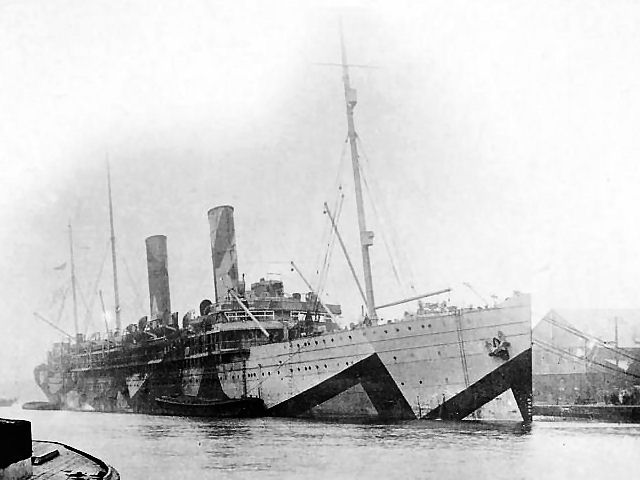
HMS
Kildonan Castle,built by Fairfield Shipbuilding & Engineering
Co.completed 1899,tonnage of 9652grt, a length of 533ft, a
beam of 59ft 2in and a service speed of 17 knots.
Sister
of the Kinfauns Castle she was the last mail ship to be completed
for Castle Line before the merger but commenced her career
as H. M. Transport 44 for use during the Boer War. On her
maiden voyage she carried 3000 troops to Cape Town and in
December 1900 was used as a prisoner of war ship at Simonstown.
During 1901 she returned to Fairfield's for completion before
undertaking her first commercial mail sailing on 7th December.
On 31st October 1914 she undertook an emergency sailing to
Lisbon where she loaded 10,000 rifles and 1,000,000 rounds
of .303 ammunition which she then took to the Cape to replenish
South African troops who were quelling secessionist strikes
in the Rand and Johannesburg.
On
6th October 1915 she was commissioned as a hospital ship with
603 beds but in the following March she was de-commissioned
and converted into an Armed Merchant Cruiser and on 21st August
1916 joined the 10th Cruiser Squadron which was based at Glasgow.
In 1917, on 17th January, she embarked the British Military
Mission headed by Viscount Milner at Oban and took them to
Murmansk where the Mission failed to prevent the Russians
from negotiating with the Germans for peace. The Treaty of
Brest-Litovsk, when Russia signed a separate Peace Treaty
with the Central Powers, was signed on 2nd March 1917 the
day the Mission reached Scapa Flow.
On
her return she undertook convoy duties in the North Atlantic.
In December 1918 she was stood down as an AMC and transferred
to the work of repatriating troops and in 1919 carried troops
to Archangel to quell internal fighting and was the last ship
to leave when the Allies withdrew. She then made a single
trooping voyage to Shanghai before sailing to Vladivostock
where, in March 1920, she embarked 1800 Yugoslavian refugees
and took them to Gravosa in the Adriatic.
At
the end of that year she was refurbished and returned to the
mail run where she remained until replaced by the Carnarvon
Castle in 1936 and put in reserve. When the building of the
Dunbar Castle was delayed in January 1930 she was deployed on
the Intermediate run until the May when she was laid up at Netley
pending disposal. She was sold in May 1931 for £11,250
and broken up at Stavanger in Norway.